
What Is a Cystectomy, and When Is It Needed?
Authored by:
Dr Gaurav Aggarwal (Uro-oncologist and Robotic Surgeon)
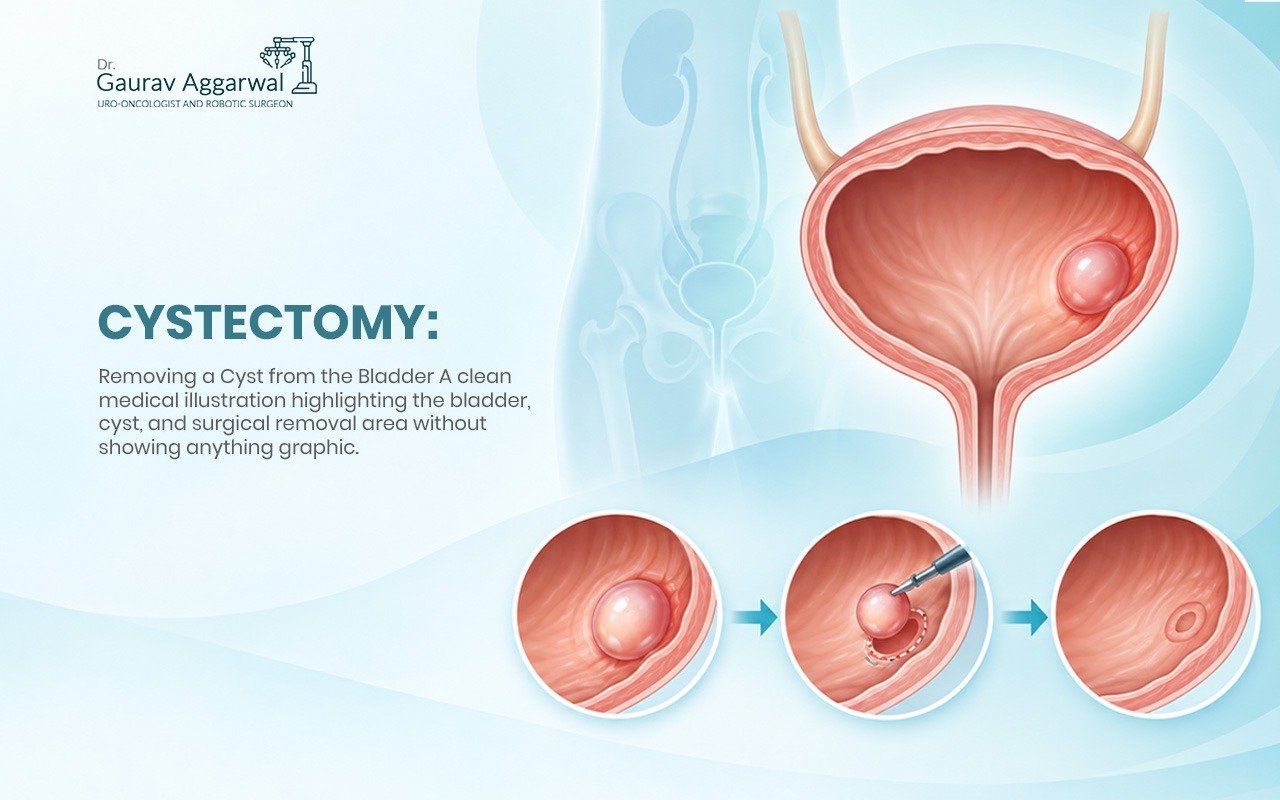
A cystectomy is the surgical removal of the bladder. If you or someone you know has been told this surgery might be necessary, you probably have questions. What does it mean to lose your bladder? How does the body handle urination afterward? Is this really the best option? This guide walks through what a cystectomy actually involves, why doctors recommend it, and what to expect.
For most people, the bladder is invisible—you simply use the bathroom when you need to. But when bladder cancer develops or certain conditions damage the bladder beyond repair, removal becomes the best path forward. What a cystectomy isn’t is a small procedure. It’s a major surgery that changes how your body functions. Understanding it means understanding both the surgery itself and the real reasons your doctor is recommending it.
What Is a Cystectomy: The Basic Definition
What is a cystectomy in the simplest terms? It’s the surgical removal of the entire bladder. In men, this usually means removing the bladder, prostate, and seminal vesicles. In women, it means removing the bladder, uterus, ovaries, and part of the vagina. The surgeon doesn’t just take out the organ and leave nothing. They reconstruct a way for urine to leave the body.
After a cystectomy, urine has nowhere to go in the traditional sense. The body needs a new path for waste. Surgeons create this through:
- A urostomy (ileal conduit) – using a small piece of intestine to create a new passage for urine to an opening in the abdomen
- A continent pouch – reshaping the intestine to create an internal reservoir that you empty through a catheter
- A neobladder – reconstructing a bladder-like pouch from the intestine so you can urinate more naturally, though typically you’ll need to catheterise
The type of reconstruction depends on your age, health, cancer stage, and preference.
Why Doctors Recommend Cystectomy
The most common reason for cystectomy is bladder cancer, particularly muscle-invasive bladder cancer that has penetrated deep into the bladder wall. At this stage, removing the entire bladder gives the best chance of eliminating cancer completely. Radiation and chemotherapy might shrink tumours, but they don’t guarantee the cancer won’t return. A cystectomy removes the source.
Cystectomy is also recommended for:
- Bladder cancer that has spread to the prostate (in men) or upper vagina (in women)
- Recurrent bladder cancer that keeps returning after other treatments
- Severe bladder damage from radiation therapy
- Neurogenic bladder that’s become untreatable and is causing serious infections
- Bladder rupture or trauma that can’t be repaired
- Chronic inflammation that has damaged the bladder beyond function
For cancer specifically, the decision comes down to this: bladder cancer is treatable, but only if caught and treated aggressively. What a cystectomy represents is that aggressive treatment—removing the problem before it spreads further.
Understanding the Surgery Itself
This is major surgery requiring general anaesthesia and typically takes 3 to 5 hours. The surgeon makes an incision in the lower abdomen to access the bladder. They remove the bladder along with surrounding lymph nodes (to check for cancer spread). Then they create the new urinary system.
Robotic surgery has changed how this procedure is performed. Instead of one large incision, the surgeon makes several small ones and works through a robotic system, which allows for greater precision. Robotic cystectomy reduces blood loss, shortens hospital stays, and speeds recovery compared to open surgery.
During surgery, several things happen:
- The bladder is removed completely
- Nearby lymph nodes are taken and tested
- The urethra is carefully handled to preserve as much function as possible
- The new urinary pathway is created using intestinal tissue
- All connections are tested to ensure they work correctly
- Drains are placed to prevent fluid buildup
The surgery is complex. Recovery takes weeks, not days.
What Recovery Actually Looks Like
After cystectomy, you’ll spend 2 to 4 days in the hospital. Pain management is essential for the first few weeks. Most people need 4 to 6 weeks before returning to normal activities, though full recovery takes closer to 8 to 12 weeks.
During recovery:
- You’ll have a catheter (tube) draining urine into a collection bag – this prevents pressure on the new system while it heals
- Drains remove fluid from the surgical site to prevent buildup
- Pain medication helps manage discomfort as you heal
- Diet progresses gradually from liquid to solid food
- You’ll need to learn how to manage your new urinary system
- Follow-up appointments monitor healing and teach you self-care
The first few weeks feel heavy. You have tubes, pain, and limited mobility. But each week improves. By 4 to 6 weeks, most people feel substantially better. By 3 months, they’re back to their regular routines—just with a different way of managing urination.
Adjusting to Life After Cystectomy
The permanent change is learning to manage urine without a bladder. If you have an ileal conduit (the most common reconstruction), you’ll wear a pouch on your abdomen that collects urine throughout the day. You empty it when needed—typically 4 to 6 times daily. It becomes routine, like any other daily task.
With a continent pouch, you catheterise yourself through an opening in the abdomen 4 to 5 times daily. With a neobladder, you urinate more normally but may need catheterisation occasionally.
The adjustment period is real. People report:
- Learning to manage the pouch or catheterisation effectively
- Adjusting to the physical sensation of something new on their body
- Regaining confidence in their routine and social activities
- Returning to work, exercise, and hobbies
- Adapting intimate relationships as they figure out what feels comfortable
- Managing occasional leakage and how to handle it discreetly
Most people adapt within 2 to 3 months. The key is patience with yourself during that learning period.
Why This Surgery Saves Lives
For muscle-invasive bladder cancer, cystectomy offers the best survival outcomes. Patients who undergo cystectomy have higher rates of cancer-free survival compared to those who try to preserve the bladder with chemotherapy and radiation alone. This isn’t about comfort or convenience. It’s about giving cancer the least chance to return.
What a cystectomy, when recommended, means your doctor believes removing the bladder gives you the best shot at staying cancer-free. That’s not a small thing.
Dr Gaurav Aggarwal: Bladder Cancer Surgery in Kolkata
Dr Gaurav Aggarwal is a uro-oncologist and robotic surgeon based in Newtown, Kolkata, specialising in bladder, prostate, kidney, and testicular cancers. With over 1,500 documented robotic procedures, Dr Aggarwal has extensive experience performing cystectomies with robotic precision.
Robotic cystectomy with Dr Gaurav Aggarwal means smaller incisions, reduced blood loss, and faster recovery—advantages that matter when you’re already facing major surgery. The precision of robotic surgery allows for careful reconstruction and thorough lymph node removal, both critical for cancer outcomes.
If you’re facing a cystectomy recommendation or want a second opinion on bladder cancer treatment, connect with Dr Aggarwal’s office. You can find detailed information about services and how to schedule a consultation at drgauravaggarwal.in.
FAQ
-
Can you live a normal life after a cystectomy?
Yes. After adjusting to the new urinary system (usually within 2–3 months), most people return to work, exercise, hobbies, and social activities without significant limitations.
-
Is cystectomy the only treatment for bladder cancer?
For muscle-invasive bladder cancer, cystectomy offers the best survival outcomes. Earlier-stage cancers may be treated with chemotherapy, radiation, or bladder-sparing approaches depending on the specific situation.
-
How long does the surgery take?
A cystectomy typically takes 3 to 5 hours, depending on complexity. Robotic surgery is generally faster and associated with less blood loss than open surgery.
-
Will I need special care for the rest of my life?
You'll manage your urinary system daily (wearing a pouch, catheterising, or urinating through a reconstructed bladder), but this becomes routine. Regular follow-up appointments monitor for cancer recurrence.
-
How do I know if I'm a candidate for robotic cystectomy?
Most people with bladder cancer are candidates for robotic surgery, though your surgeon will evaluate your health, age, and cancer stage to determine the best approach for your situation.
