
How Robotic Technology Improves Precision During Lymph Node Surgery
Authored by:
Dr Gaurav Aggarwal (Uro-oncologist and Robotic Surgeon)
When cancer spreads, it doesn’t travel randomly. It follows a predictable path through the lymphatic system. Surgeons have known this for decades. What changed in the last ten years is our ability to see and remove only the affected nodes—without collateral damage.
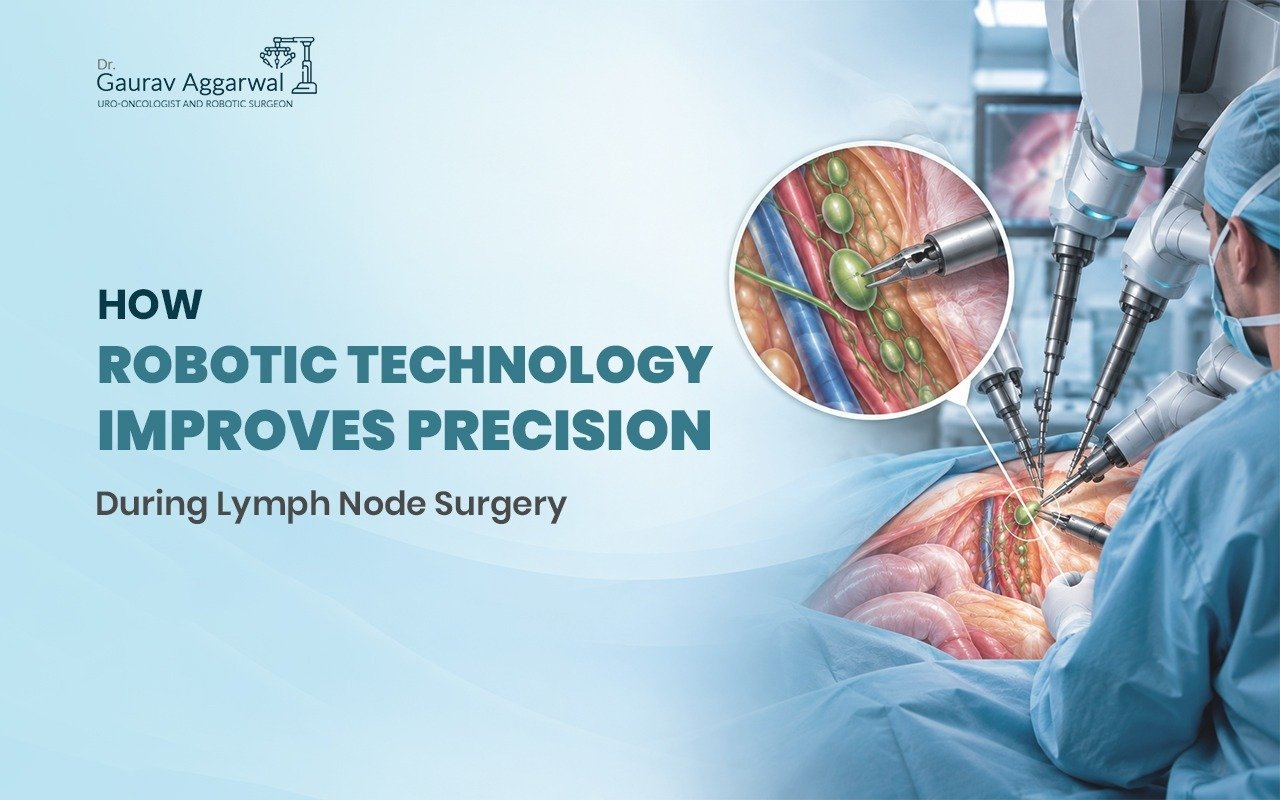
Robotic technology during lymph node surgery has redrawn what’s possible. Instead of making large incisions to find and remove lymph nodes, surgeons now work through 4-5 tiny openings. The robot’s camera shows a magnified, three-dimensional view. The instruments move with precision that human hands alone cannot replicate. The result: fewer complications, faster recovery, and better cancer outcomes.
This shift has been transformative for urological cancers. Prostate cancer, kidney cancer, and bladder cancer all rely on accurate lymph node assessment. Understanding whether cancer has spread to the nodes changes everything—from staging to prognosis to treatment decisions.
Why Lymph Nodes Matter in Cancer Surgery
The lymphatic system is the body’s early warning system. When a tumour grows, cancer cells often reach nearby lymph nodes first. If nodes are clear, the cancer is localised. If nodes are involved, the cancer has begun to spread.
For urological cancers, this matters surgically:
- A surgeon needs to know which nodes are involved before operating
- Removing too many nodes causes long-term swelling (lymphoedema)
- Leaving involved nodes in place misses the cancer
- The nodes are deep—buried in fat and tissue, near vital blood vessels and organs
Traditional open surgery required large incisions to access these areas safely. A surgeon could see, but only from one angle. Palpating tissue (feeling with gloved hands) helped identify nodes, but it wasn’t precise. Some nodes stayed behind. Others got removed unnecessarily.
How Robotic Lymph Node Surgery Works
Robotic technology doesn’t replace the surgeon. It extends the surgeon’s ability.
The setup:
- Anaesthesia is induced, and the patient is positioned for access to the surgical area
- 4-5 small incisions (about 8-12 mm each) are made
- A camera (called an endoscope) goes through one port; instruments through the others
- The surgeon sits at a console 10 feet away, controlling the robot’s arms
The precision advantage:
- The camera magnifies the area 10-12 times
- The image is three-dimensional, giving true depth perception
- The surgeon’s hand movements are scaled down—a 1cm hand movement becomes a 1-2mm instrument movement
- Tremor is filtered out automatically
- Articulated instruments bend and rotate in ways human wrists cannot
What the surgeon sees:
- Individual lymph nodes sitting in their tissue beds
- Nearby blood vessels and nerves in high definition
- The exact plane between healthy tissue and cancerous tissue
- The ability to remove nodes without damaging structures nearby
The Clinical Advantage
Studies from urology centres across India and globally show consistent benefits:
Better cancer staging:
- More nodes are identified and removed when indicated
- Staging accuracy improves, meaning treatment is based on complete information
- Understaging (missing nodes) drops significantly
Reduced side effects:
- Lymphoedema rates fall because only necessary nodes are removed
- Infection risk is lower—smaller incisions mean less tissue trauma
- Nerve injury is less common because visualisation is superior
Faster recovery:
- Patients go home 1-2 days after surgery instead of 3-5 days
- Return to normal activity happens in 2-3 weeks instead of 6-8 weeks
- Pain is minimal—small incisions mean minimal wound pain
Better long-term outcomes:
- Cancer recurrence rates reflect improved staging and more complete node removal
- Quality of life improves because complications are fewer
Lymph Node Surgery in Different Urological Cancers
Prostate cancer:
- Robotic-assisted lymph node removal happens during prostatectomy
- Nodes in the pelvis are accessed safely through the same small incisions
- Precision matters because nearby nerves control sexual and urinary function
Kidney cancer:
- Nodes around the kidney and in the retroperitoneum (behind the abdomen) are difficult to reach
- Robotic access allows removal without opening the belly fully
- The surgeon can work in a confined space without hand strain
Bladder cancer:
- Pelvic lymph node removal is standard before removing the bladder
- The robotic approach is gentler on surrounding tissue
- Recovery is faster, which matters because bladder cancer patients often need follow-up chemotherapy
Testicular cancer:
- Nodes in the retroperitoneum are deep and close to major blood vessels
- Robotic magnification reduces the risk of vascular injury
- Even small errors matter in this delicate region
What to Expect: Before, During, and After Robotic Lymph Node Surgery
Before surgery:
- Imaging (CT or MRI) identifies the location of nodes needing removal
- Blood work and cardiac clearance are standard
- You’ll meet the surgical team and anaesthesiologist
- Fasting instructions are given (usually 6 hours before surgery)
During the procedure:
- Total time in the operating room is typically 2-4 hours depending on the extent of lymph node surgery
- You’re under general anaesthesia the entire time
- The robotic system is positioned, and small incisions are made
- Node removal takes place; tissue is sent to pathology
- Incisions are closed with dissolving stitches or clips
After surgery:
- Recovery room monitoring for 1-2 hours
- Most patients go home the same day or the next morning
- Pain is managed with oral medication
- Activity restrictions are minimal—walking and light movement start immediately
- Shower restrictions apply to incisions until they’re sealed (usually 3-4 days)
- Follow-up is at 1-2 weeks, then 4-6 weeks
Robotic Lymph Node Surgery: Key Advantages
- Magnified three-dimensional view eliminates guesswork
- Smaller incisions reduce pain, infection risk, and recovery time
- Precise node dissection means better staging and fewer side effects
- Nerve and blood vessel injury risk drops significantly
- Patients return to normal activity faster
- Cancer outcomes improve because staging is accurate
Working With an Experienced Robotic Surgeon
Not all surgeons perform robotic lymph node surgery. The learning curve is steep. A surgeon needs hundreds of cases—not dozens—before they handle complex node dissections confidently.
Look for:
- Board certification in urology and specific robotic credentialing
- Documented experience with 1,000+ robotic procedures
- Specialisation in cancer surgery (uro-oncology)
- Access to current-generation robotic systems
- A team that follows your case before and after surgery
Dr Gaurav Aggarwal, based in Newtown, Kolkata, specialises in uro-oncology with robotic precision. His experience spans over 1,500 robotic procedures, with particular expertise in lymph node dissection for prostate, kidney, bladder, and testicular cancers. You can learn more at drgauravaggarwal.in.
FAQ
-
Will I have drainage tubes after robotic lymph node surgery?
Small drain tubes are sometimes placed to prevent fluid buildup, but they're removed within 24-48 hours. Most patients leave without drains.
-
Can I get robotic lymph node surgery if I'm overweight or have had previous abdominal surgery?
Yes. Previous surgery may require careful planning, but it's rarely a contraindication. Your surgeon will assess based on imaging and your medical history.
-
How long does it take to feel completely normal after lymph node surgery?
Most patients feel 80-90% normal within 2-3 weeks. Full return to strenuous exercise takes 4-6 weeks.
-
Is robotic lymph node surgery available in Kolkata?
Yes. Robotic surgical facilities are available at major cancer centers and hospitals. Surgeons like Dr Gaurav Aggarwal offer robotic lymph node surgery with extensive uro-oncology training.
-
What happens to the lymph nodes after they're removed during surgery?
Nodes are sent to pathology for examination under a microscope. Results guide follow-up treatment decisions and help confirm cancer staging.
